Your pet is changing vets: how to pass on what matters
A move, a new clinic, an on-call vet on a Sunday evening: sooner or later, your pet ends up in front of someone who does not know it. That fear of "forgetting everything" is valid. A few landmarks are enough to make sure the essentials follow your pet.

When the vet doesn't know your pet
A move, a clinic that closes, a second opinion, a specialist, an on-call vet in the evening or at the weekend: there are many occasions when your pet ends up in front of someone who has never seen it.
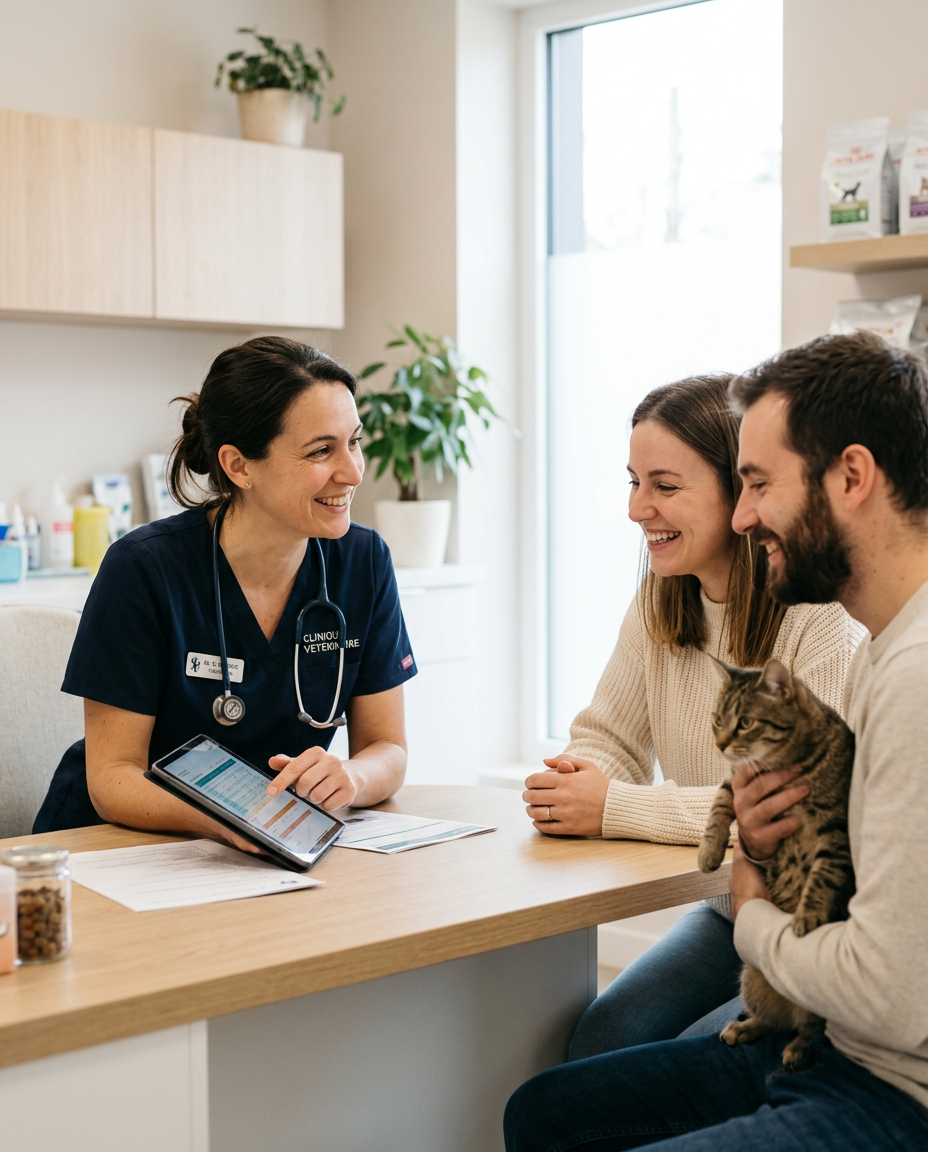
At those moments, there is often the same twinge: will I remember to say everything? That reflex is not excessive. It comes from something very accurate: the vet has the examination in front of them, but not your pet's past. What it has already been through, what was prescribed, what you were asked to keep an eye on: all of that stayed in another file, or in your memory.
The goal is not to tell everything. It is to hand over the essentials, in a clear order, so that the vet can start with your pet rather than with a questionnaire.
The essentials to pass on, in five landmarks
No need for a thick file. Five landmarks are enough, and you already have most of them:
- Who your pet is. Name, species, age, breed if you know it, and the name of its previous clinic.
- Its known care history. Vaccines with their dates if you have them, past consultations and their reasons.
- What it is receiving now. Treatments, supplements, food, with names and start dates as they appear on the packaging or prescriptions.
- Its habits. Appetite, daily rhythm, temperament, what it finds hard at the vet's.
- Why you are coming. The reason for today, in facts: since when, how often, in what circumstances.
If you don't know, say so as it is. "I can't remember the date" is better than an invented date: the vet will know what can be checked.
What is normal for your pet
This is the most valuable information, and the most invisible. For a vet meeting your pet for the first time, a quiet cat or a very calm dog may seem perfectly normal, or on the contrary subdued. Only you know what is typical for it.
A few sentences are enough: "Usually, it eats as soon as the bowl is filled." "It always hides at the vet's, that's nothing new." "It sleeps a lot in the afternoon, that's its rhythm." These landmarks let the vet compare what they see with what you know about your pet.
If you have kept a journal, reread it before the appointment: it holds the small changes of recent weeks, and what has not moved. If not, write these few lines in your phone before you leave.
Recovering the earlier history
You no longer have the health booklet, or it stayed at the old clinic? It happens, and it is not a fault. Here is how to rebuild the essentials without stress:
- Note what you remember: the broad outline is better than nothing.
- Gather what you already have: booklet, prescriptions, reports, invoices, photos of documents on your phone.
- Ask your previous clinic what it can pass on to you, depending on how it works.
- Start a journal now, even a short one, so that the next change goes more smoothly.
An incomplete history does not prevent a consultation. What matters is being clear about what you know and what you don't.
On call or in an emergency: the history within reach
The on-call vet knows neither your pet nor its file, and the situation leaves little time to rummage through drawers. What you have to hand at that moment makes all the difference.
When the history is gathered in one place, you can show or send it in a few taps, and the person in front of you can read it before asking their first questions. That is the idea behind Charly's health passport: the animal has a history, and has it with it everywhere, all the time. A link to its journal or a PDF export is enough.
Also keep your usual clinic's number and that of the on-call service in your area within reach. On the phone, describe first what you have observed. If you are unsure how urgent it is, call: the veterinary team will tell you how to proceed.
This article offers guidance on observing and describing. It does not replace your veterinarian's advice. If in doubt, contact your clinic.